Inner peace is an aspect of your attention. It lies hidden within attention, waiting to be discovered in any waking moment. It is subtle — so subtle that many people go decades without noticing it. I was one such person until age 28, when I first felt it.
Attention is usually focused on something: a thought, an emotion, a sensation, or a perception. It takes on the qualities of whatever it notices:
When it rests on fear, the breath becomes shallow and the body tenses.
When it rests on a sunset, colours and patterns fill the mind.
But what happens if attention notices itself? Would there be anything to feel at all?
Yes. When attention turns towards itself, it begins to feel peaceful. Instead of taking on the qualities of what it notices, it starts to sense its own quiet nature. This is called attention of attention. And it's available to you, even now.
Full vs. Free Attention
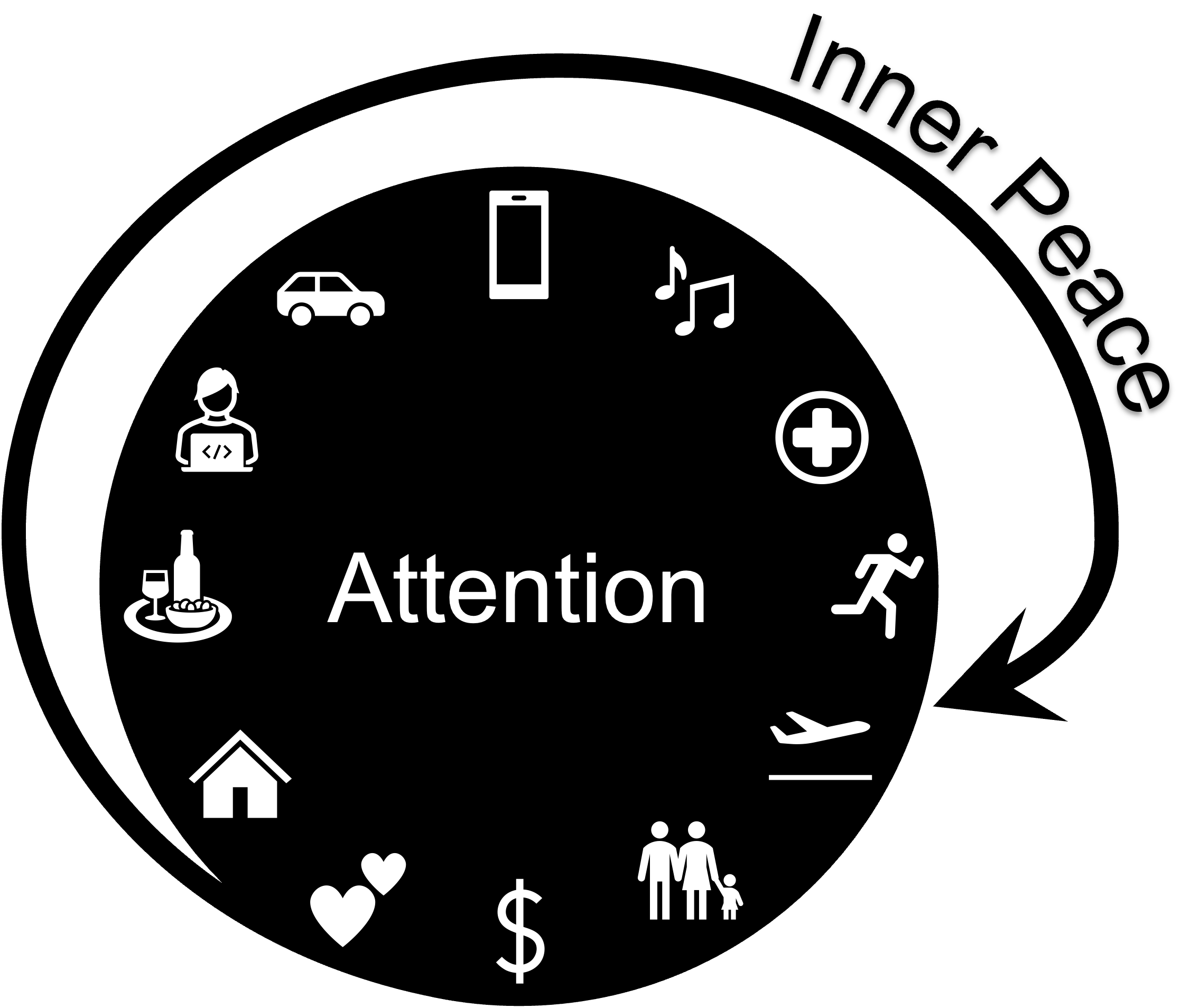
Occupied attention knows only the qualities of what it holds: pain, pleasure, memories, music, sunsets, thoughts, cravings, fears, or desires. Only unoccupied, "free" attention has the potential to turn and look at itself. And when left free, it often does so naturally, quietly noticing its own presence.
Let's invite attention to free itself, and then to notice itself. Try this simple exercise:
Relax the focus of your attention. Don't concentrate on anything in particular. Let everything soften. Just be gently aware of the sights and sounds around you.
Now notice the place from which you are aware. If you stop chasing what's appearing and instead rest with what's watching, something quiet and still might begin to show itself.
This exercise might not reveal anything at first. Attention is often busy chasing things and isn't used to looking at itself. But you can try it again whenever you feel calm and open: while walking in a park, chopping vegetables, folding laundry, or holding a stretch.
The fundamental barrier to inner peace is the lack of free attention in daily life. Attention is entangled in thoughts, tasks, and emotions from morning to night. Many of these are necessary for survival and comfort. But even when everything is done, attention rarely stays free. Thoughts rush in, emotions surge, or we reach for the next distraction at the first sign of boredom. From a young age, attention has been trained to stay full, which is why free attention is so rare. Yet even a few moments of free attention can begin to reveal inner peace.
Most of us now keep attention full on purpose. We pull out our phones and start scrolling the moment there's a pause: waiting in line, between sets at the gym, or even while walking. The apps we scroll are designed for one thing: capturing attention. Behind them are teams of world-class engineers and psychologists. With the rise of smartphones, human attention has been further conditioned to stay occupied all day long.
Here are some examples of how attention stays full through ordinary distractions:
Walking to the store, lost in thought
Driving on autopilot, barely noticing your surroundings
Eating a meal while watching TV or scrolling your phone
Reaching for notifications the moment you wake up
Watching a show while also texting or chatting
Filling every silence with music instead of noticing the quiet
Here are some further examples of how attention remains entangled in deeper set habits and patterns:
Chasing one pleasurable experience after another
Worrying about future events and "what ifs"
Spinning little stories about yourself and others
Criticizing yourself internally, even in quiet moments
Repeating old relationship patterns and emotional loops
Replaying memories of past events
Experiencing flashbacks of painful or traumatic moments
Escaping old wounds by drowning attention in distraction or addiction
Recognizing these patterns is not about judgment, but about freeing even a little attention from them, enough for inner peace to begin shining through.
Making Room
We begin exactly as we are: active and productive, yet often distracted, anxious, or carrying old wounds. The point is not to change our lives overnight, but to work within the daily routines we already have.
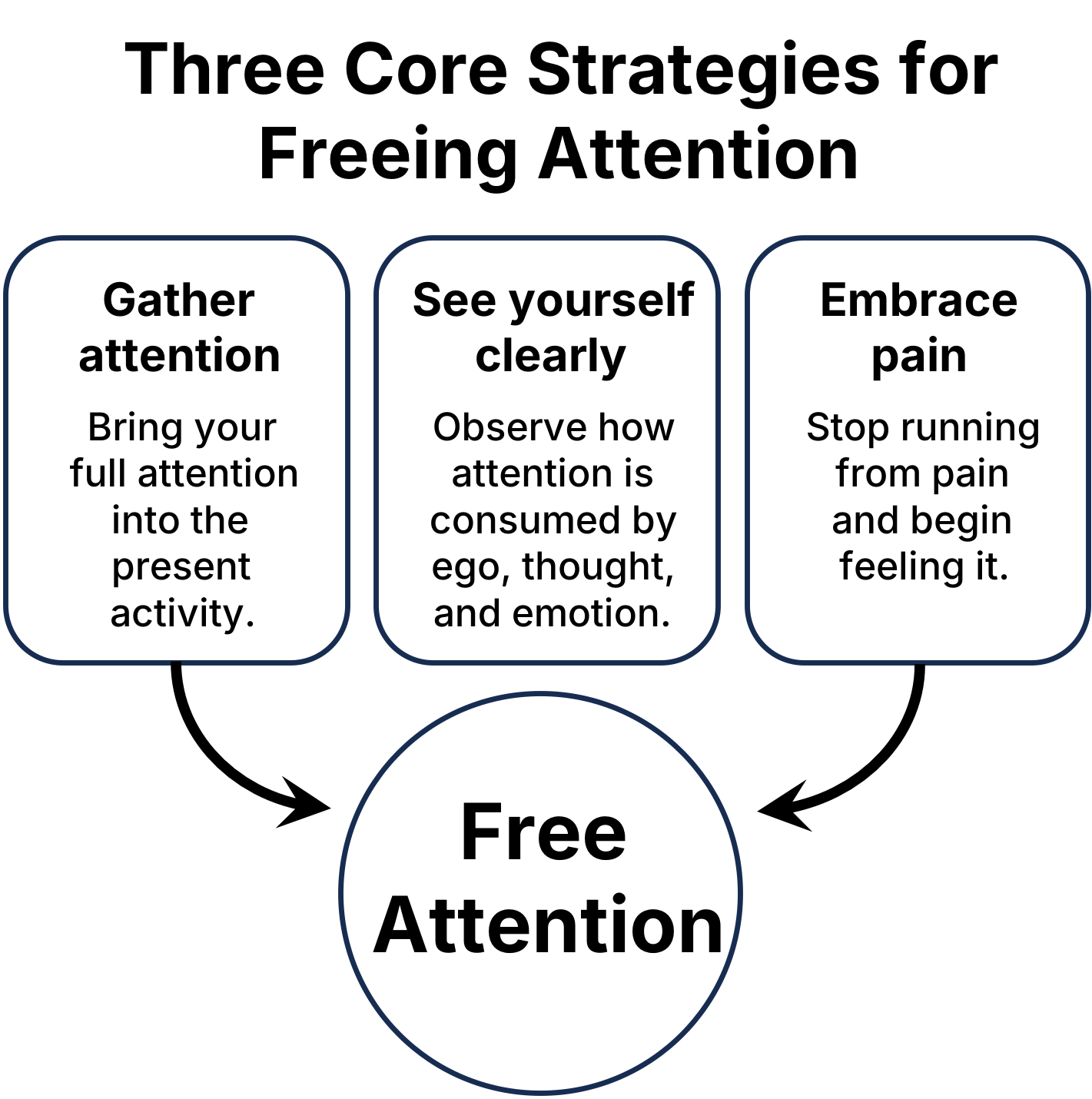
Freeing attention is a skill that can be learned. There are three core strategies: gather attention, see yourself clearly, and embrace pain.
Gathering attention means bringing your full attention to the task at hand. Attention is often scattered across multiple threads that run in the background. I might cut vegetables, cook, eat, and do the dishes, all while a train of thought carries on unnoticed. That thinking thread weaves through everything, quietly absorbing whatever free attention might have been available. The remedy is to reclaim attention from background noise by gathering it into the present moment.
Seeing yourself clearly means to become aware of habitual narratives and emotions. Words are endlessly flexible, especially the ones we speak to ourselves. In the privacy of your own mind, you might glorify yourself, judge others, or bend the truth to protect an old belief. You might even reach for your phone to find confirmation for what you already believe. This ongoing mental theatre quietly consumes a great deal of attention. Free attention enters the picture the moment you notice these patterns. It lets you choose how to respond — and grows stronger each time you do.
Embracing pain means turning towards so-called "negative" emotions like anxiety, grief, anger, and shame. These may arise from present-day circumstances or be held in the body from past trauma. Because they feel so unpleasant, we often try to outrun them. But when we stop and face them, they begin to release the charge stored within them, freeing up attention that was previously trapped inside.
Each strategy frees attention in a different way, and together, they make room for inner peace to arise naturally. They also improve how you live now:
Gathering attention brings greater quality to what you do.
Seeing yourself clearly allows you to act wisely, even when internal narratives are harsh or distorted.
Embracing pain reduces the influence of old wounds on your relationships.
Our goal is to return attention to a balanced state: a sweet spot between occupancy and vacancy. There can be no inner peace without some vacancy. And there can be no worldly effectiveness without occupancy.
The Taste of Peace
Describing the felt sense of inner peace is like trying to explain the taste of chocolate, the ache of heartbreak, or the beauty of a sunset to someone who has never known them. Words can point, but they cannot replace direct experience.
Still, I will try. My description is drawn from sixteen years of living with inner peace as a growing presence in my life, and from the voices of humans across millennia who have tasted it in their own ways. My hope is that these words help you recognize it when it appears, even briefly, in your own life.
I use the phrase inner peace as shorthand for what attention noticing itself feels like. Here are some of its central qualities:
Peace: Many things arise within attention to create disturbances, yet attention itself is deeply peaceful. It holds all of life gently, whether it is pleasure or pain, loss or gain. It runs deeper than happiness or sadness.
Stillness: Attention of attention has never changed since I first noticed it. Only its intensity changes with the demands of the moment. It rises into the foreground when free attention is abundant, such as during walking or driving. But it recedes into the background during busy moments, like writing this book or playing with my nephew.
Clarity: The world feels fresh, unstained by past impressions. A part of attention observes internal narratives and reactions with a kind of disbelief; there's an underlying sense that I'd rather know the truth than be right.
Wholeness: While the mind can divide reality into parts, attention of attention sees it as undivided. This makes it easier to perceive the big picture rather than get lost in the details.
No-thing-ness: Attention is not a "thing" at all. It has no structure or dimensions that I can detect, yet it contains everything, including my body, thoughts, emotions, and experiences. It is more like an open space of awareness than any object within it.
When attention turns towards itself, these qualities are sometimes accompanied by a subtle high-pitched vibration or ringing. Across traditions, this has been called the sound of silence, the cosmic tone, the inner hum, or the pulse of nothingness. It may seem to come from within the ears or from everywhere at once. It isn't tied to any external sound, though it resembles the fading ring of a bell. Its presence is simply a signpost that attention is resting deeply within itself. The intensity of this tone rises and falls depending on how much free attention is available.
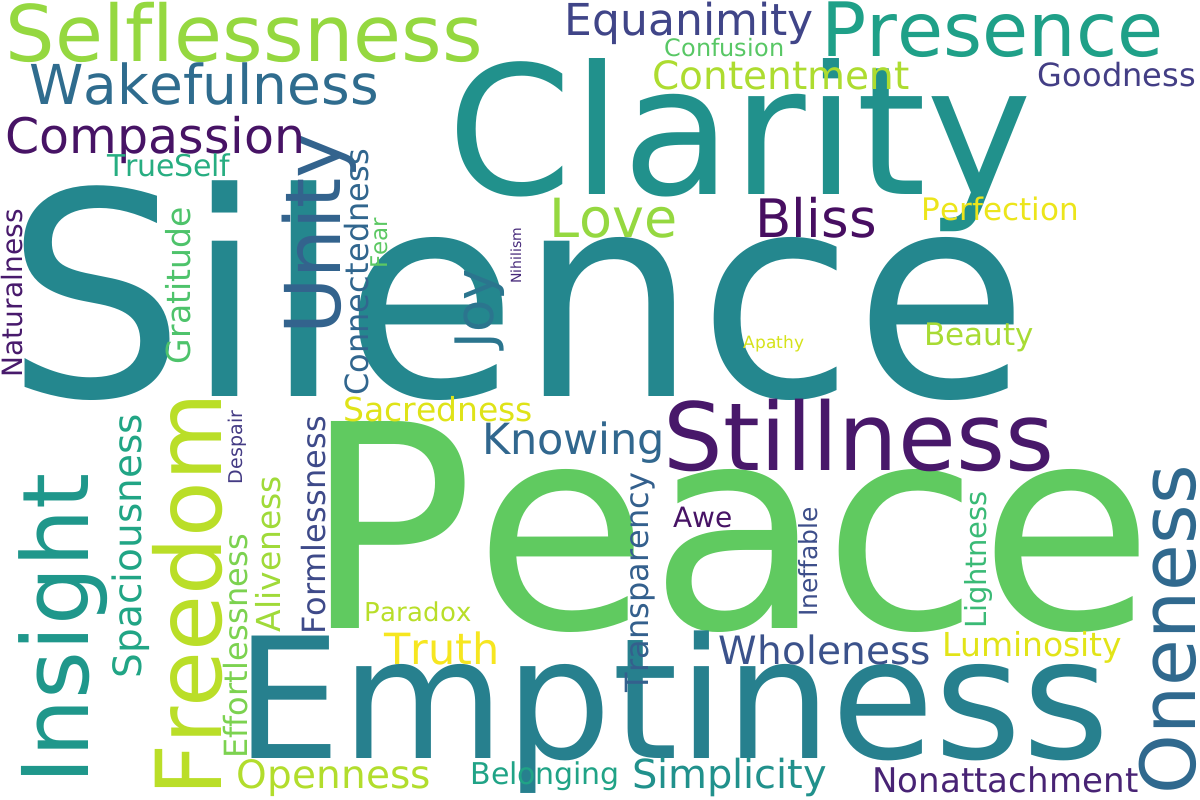
To broaden the view beyond my own, I gathered descriptions from spiritual, religious, secular, artistic, and scientific sources. The top qualities of attention, drawn from literature and first-person accounts, are shown in the word cloud below. The larger the word, the more often it appeared in the search. Positive qualities dominate, though a few negative ones, such as fear or nihilism, are included for completeness. Seeing them together offers a glimpse of the shared human intuition about what attention, in its purest form, is like.
If I had to choose one word for the essence of attention, it would be goodness. Although human attention can be clouded by ego, compulsive thought, emotional loops, or trauma, its core holds qualities with the power to transform both the individual and society for the better.
Common Pitfalls
Who wouldn't want more peace, stillness, and clarity in this agitated world? But even the search for peace can lead into traps. Let me illuminate a few common ones, so you can avoid them.
Passivity: Since attention can be freed by withdrawing from the world, living in seclusion, or avoiding responsibility, it's easy to assume that inner peace lies in retreat. While this may feel good for some time, it doesn't yield the practical benefits of inner peace. Health, meaningful work, and nurturing relationships can only be cultivated in the world, not apart from it.
Inner peace reached through passivity is often unstable, because the forces that capture attention haven't been overcome — only sidestepped.
Misplaced empathy: The journey into inner peace is a universally human one. Along the way, it's natural to feel empathy for those still caught in ego and cut off from the goodness within. But this can easily slide into naïveté. Actions are the only reliable indicator of someone's inner state, and it's best to engage with people accordingly.
Some free attention is needed for a person to introspect and self-regulate. In its absence, only the external world can provide checks on harmful behavior. Compassion must be paired with discernment.
Perfectionism: Inner peace is intense when free attention is abundant and content to rest in itself. These states can feel so "perfect" that we begin to crave them. But impatience, frustration, or old mental loops may still arise. Actions may reveal themselves as flawed with the benefit of hindsight. Inner peace is perfect, but no human being is. Trying to be or become perfect can ironically push peace away.
Don't go to war with yourself. Let yourself be human.
Inner peace is not an escape from the world, but a way of being within it. It reaches its fullest depth only through the realities of daily human life.
How It Changes You
Inner peace, at the very moment of its arising, is a gap: a gap of free attention. A gap between attention and things. A gap between awareness and what it is aware of. Paradoxically, this gap is brimming with the inherent qualities of attention: peace, stillness, clarity, and so on. It is a gap full of goodness. Over time, as inner peace stabilizes, this gap begins to infuse every area of life: thinking, feeling, sensing, relating, working, creating, even moving.
This gap between attention and things impacts life in two ways.
First, being alive feels better. As I write this with the subtle hum of silence in the background, I feel glad to simply be alive. There is a quiet contentment that exists before anything goes right or wrong. I used to be far more at the mercy of my thoughts, emotions, and circumstances. Life revolved around the things that occupied my attention, and the difficulties inherent in living would often destabilize me at the core. Inner peace has since become the unshakeable foundation of life: a calm centre from which to move.
Second, the gap alters how attention meets things. Ordinarily, attention is tightly fused with its contents. Without space, it becomes difficult to observe yourself, release old patterns, welcome new insights, or act differently from your conditioning. With inner peace, attention softens. Thoughts and emotions can be seen more clearly, and new actions and habits can take root with less resistance.
Below are some of the ways inner peace can impact life at the individual level:
Resilience: Life is difficult. It brings laughter and tears, love and heartbreak, gain and loss. Inner peace anchors these ups and downs. Even as part of your attention is swept into the ride, another part holds steady — free and aware.
Emotional regulation: Negative emotions are part and parcel of life. Fear helps us prepare, anger sets boundaries, and sadness allows us to grieve. But emotions can also flare beyond what is helpful, leading to impulsive words and actions. Inner peace provides enough space to feel without reacting. It supports wise action even when emotions run high.
Productive thinking: Thought is humanity's greatest tool. We've used it to carve civilization from nature. But since thought is essentially a voice in the head, it can also whisper lies and half-truths straight into our ears. A gap between attention and thought is vital to sidestep internal storytelling, ego, assumptions, and other distortions that thought can impose on situations, people, and ourselves.
Better decisions: When attention doesn't cling to the thoughts and emotions that arise within it, a situation becomes visible from many perspectives. A good starting point is no perspective at all — just the naked reality as it is. From there, the full range of resources available to you, including the viewpoints of others, can inform the actions you take.
Deeper connection: Relationships are fertile ground for ego, judgment, reactions, and identity to arise. These forces often act as barriers. Inner peace invites us to see them clearly and move beyond them. It offers the chance to lessen our baggage, return to neutral, and connect more openly with those around us.
Health: Inner peace won't eat, run, or lift weights for you. It's no substitute for caring for your body. But it creates some distance from stress, illness, and pain, making them less overwhelming. By calming the nervous system, it helps the body shift out of fight-or-flight and into a state of rest and repair.
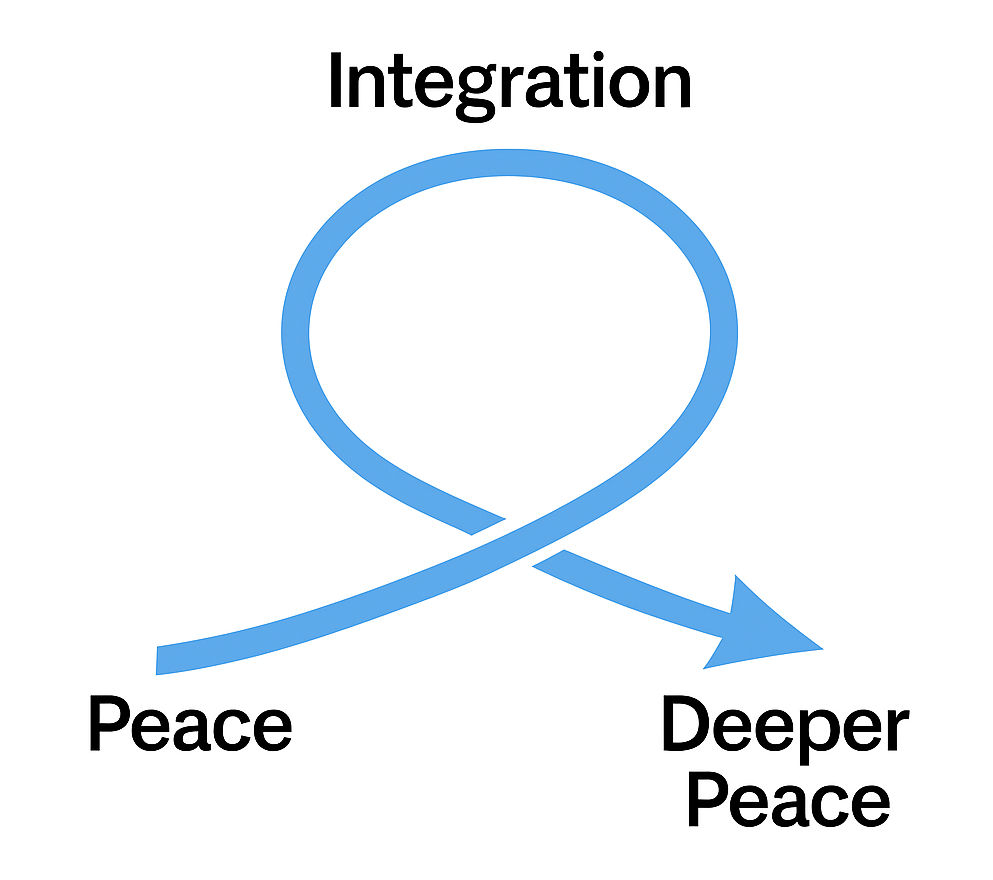
So what comes first, inner peace or its benefits? After all, we seem to need free attention to access inner peace. But I'm also saying that peace itself helps free attention from habits like rumination and reactivity.
Inner peace operates as a virtuous cycle. When we invite peace by freeing attention during everyday activities, it begins to grow. Over time, it integrates into more areas of life — thinking, feeling, relating — and returns as even deeper peace. This loop becomes self-sustaining. Eventually, peace becomes the foundation from which all action arises.
From Peace to Power
Inner peace isn't meant to be the main course in life. But it makes a wonderful plate on which everything else is served. It's the most stable foundation you can uncover, one that infuses goodness into the very core of living. It would almost be a shame not to build upon it.
Anything you build requires skill, whether it's your body, a relationship, a family, a career, or even a hobby. And skill can be honed to the point of excellence. It can be driven by needs, wants, ego, status, enjoyment, or sheer hard work. You will meet many people who succeed without inner peace.
Peace isn't the only path to excellence. But it's the most honest and grounded one. It also makes a real difference in getting good at something. Here's how:
Authenticity: Society makes a lot of noise, and it's easy to chase goals it loudly advertises. But peace clarifies who you are. And when you act from that place, effort flows more easily and work ethic deepens.
Self-knowledge: I used to think I could do anything better than anyone. I've also met people with the opposite belief. The truth lies in between: we each have a few gifts and many weaknesses. Inner peace makes it easier to see both.
Creativity: New ideas don't shout, they whisper. Without some quiet, they're drowned out. The intermittent mental silence that peace brings is a wellspring of ideas that can be tested and shaped in the world.
Mental flexibility: As the saying goes, "You can't teach an old dog new tricks". But peace fosters humility and curiosity. It helps you question your assumptions and change your mind, even as you age.
Teamwork: No one walks the path of excellence alone. You'll need to work with people of different skills and sensibilities. Peace loosens the grip of ego, softens boundaries, and makes space for collaboration.
Intelligent re-use of attention: All the attention freed from habitual thinking, emotional patterns, ego, and past pain becomes newly available. It can now be directed towards activities and projects that matter to you.
Inner peace doesn't make you smarter or more skilled on its own. It has to be baked into how you live and work. I was already a good engineer before I tasted peace. But it elevated my contributions at every stage of building a company. The person I became through peace was far more effective than who I was before.
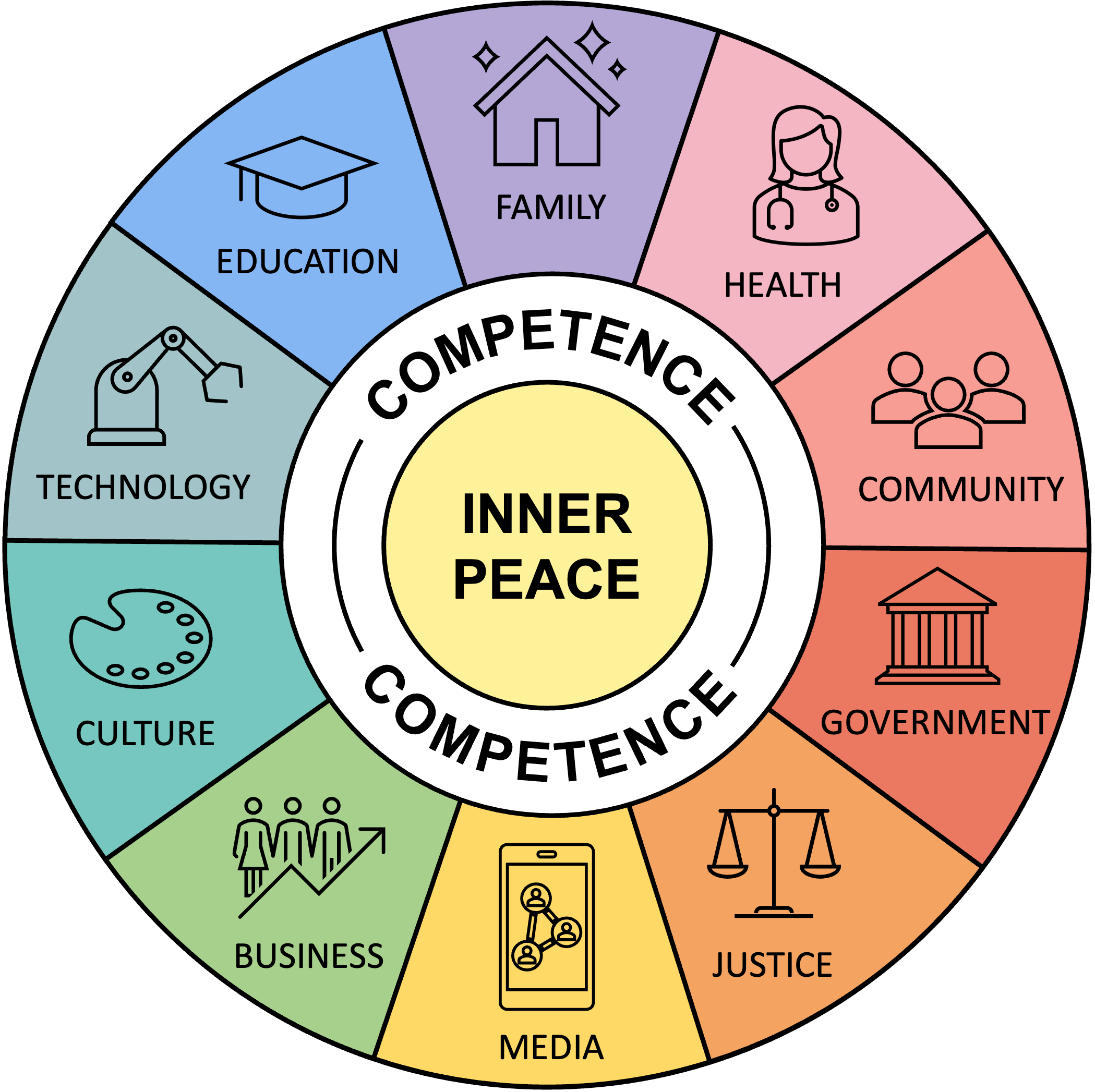
I was skilled and ambitious in one small domain: satellite imaging. But our civilization is shaped by far broader fields: technology, health, infrastructure, education, economics, governance, parenting, and more. Each of these domains is nothing more than many hearts and minds working together, including yours.
So ask yourself, based on what you've observed:
Who's making the decisions?
Who's running the show?
Is it ego, trauma, and identity?
Or is it inner peace?
It's more important than ever for people rooted in peace to step into key roles across every domain of civilization. I sincerely hope you're one of them. Two things are required: to live from inner peace, and to become deeply skilled in something. Peace rules the heart — and competence is the hand it uses to shape the world.
I'd like to see the reins of our civilization held by inner peace, not as an ideology, but through the peace-full actions of individuals. More than anything, this could become the quiet engine of our global society. The role you play is entirely up to you. What matters is that you keep cultivating peace while contributing your skills to the world. If you walk towards peace, you may just be surprised by what you are called to.
A World Awakened
Let's consider humanity as a single field of attention. With 8 billion people awake for roughly 16 hours a day, we generate about 130 billion hours of attention daily. How this collective awareness is oriented will determine the fate of planet Earth, because our actions shape the future of all life: humans and nature alike.
Let's consider two extreme scenarios.
First, imagine that all human attention is consumed by things, almost never resting within itself. You don't have to guess what that looks like; we're living it. The result is a world rich in expertise, technology, culture, and systems, but also marked by distraction, loneliness, mental illness, conflict, division, and war.
Second, imagine that all human attention was attending only to itself, utterly disinterested in shaping external things. The result might be extreme peace, but civilization would collapse. Without attention directed towards building, organizing, and maintaining the world, we would lose the very structures that support life.
So you see, attention of attention isn't better than attention on things. It's not a matter of choosing one over the other. We need both. A healthy civilization depends on attention that can both recognize itself and engage with the world. Leaning too far in either direction becomes counterproductive. Ultimately, attention is a single, continuous faculty — not something divided between itself and the world.
If our collective attention rested both on itself and on the world, the civilization we build would be unlike anything we've known. I live this way myself but cannot predict how it might scale. Still, one thing is clear: the natural qualities of attention — peace, clarity, and wholeness — would gradually shape the world around us.
If inner peace reached a critical mass, world peace would follow. If the attention driving civilization embodied clarity, the world would make less noise and honour truth more. If attention saw the world as a shared whole rather than 8 billion private playgrounds, care for others would come naturally.
I'm not proposing a utopia, only a more sane starting point. There's a striking contrast between the nature of human attention and the worst excesses of our civilization. It's challenging, but not impossible, to align the world we build with what is already true: that our attention is peaceful, clear, and whole at its core.